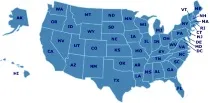
Any person operating or intending to operate a home school shall:
A. within thirty days of its establishment, notify the state superintendent of the establishment of a home school within thirty days of its establishment and notify the state superintendent in writing on or before April 1 of each subsequent year of operation of the school district from which the home school is drawing students;
B. maintain records of student disease immunization or a waiver of that requirement; and
C. provide instruction by a person possessing at least a high school diploma or its equivalent.
The education establishment has realized that the socialization issue will be seen for the red herring that it is, and has searched for other means to suppress homeschooling. Two new strategies have emerged, and these pose real threats to homeschooling. The first strategy is to argue that homeschooling needs some form of accreditation. A number of reasons have been offered: it eases the transition back to the public school for those homeschoolers who go back, it is the basis for awarding a recognized diploma, and it makes it easier to provide homeschoolers access to public school programs and facilities such as science classes, libraries, sports, etc. But accreditation is simply another word for conforming, and the desire to not conform is the fundamental reason for choosing to homeschool. Homeschoolers as a group will not be seduced nor will they be tricked by the false promises of accreditation. The second strategy for suppressing homeschooling is one that is much more likely to be successful, and it is to drastically limit homeschoolers’ access to public higher education. In this, the education establishment has discovered its only effective weapon against homeschooling.
The mission of the Center for Sports Poetry is to encourage young people throughout the United States to engage their creative spirit by writing poetry, using sport as their motif. In the tradition of honoring academic excellence, the Center will name elementary and middle school students to the Sports Poetry Honor Roll. High school and college students will be named All-American Sports Poets.
Children’s ability to understand mathematics takes a big leap forward in the preschool years. Their strengthening ability to represent using manipulatives, symbols, and signs opens up many new possibilities. Children also make strides in algebra and patterning. They can sequence events in time by age three. By age four, they can re-create patterns or make their own repeating pattern. During the preschool years, the child’s ability to problem solve takes on a new zeal. Children’s ability to classify objects is more developed; they can sort and organize objects into different categories and tell which pile has more. This chart details the skills that children can exhibit at different ages.
Beginning in the late 1970s, as parents became dissatisfied with the public education system, the modern homeschooling movement grew rapidly. The 1983 report, A Nation at Risk, confirmed some parents belief that their children were receiving a mediocre education in public schools. Research by John Holt and Dr. Raymond Moore encouraged many parents confidence in their ability to homeschool. Conflict between some Colorado public school districts and parents led to the adoption of a 1988 legislative bill that established guidelines for home education. A timeline of important events is detailed here.
Spiral Academy is dedicated to serving the needs of home school families, primarily in Colorado, who desire the benefits of private school enrollment with minimal oversight over their educational activities. Their sole intent is to lend support for academic excellence that is always conducted in the spirit of religious and cultural tolerance. Religious and political beliefs are not part of Spiral Academy's identity or purpose. Students have an eclectic mix of beliefs, political affiliation, and cultural diversity.